Test Series for UPSC (IAS) students


Commerce Gurukul is going to announce next batch (Batch No 5 ) for test series
Test series is going to start from 20 August 2017.
This test series is greatly helpful for  UPSC (IAS) students with Commerce and Accountancy optional
As test series helps  to cover syllabus as per upsc guidelines, time management, checking  progress and allot more to snatch Success.

Benefit of test series
•Discipline
•Time management
•Complete your syllabus within timeline
•Revision
•Answer writing practice
•Tricks to remember to be given
•Clear your queries via telephonic,mail or social app msg.
•Supplement by notes prepared by qualified Chartered Accountant
•Gain maximum marks in exam result

Paper  will be prepared and checked by  CHARTERED ACCOUNTANTS with 6+years of experience in teaching in relevant field.


Procedure

Topic/Chapter will be informed in advance.

Give test & submit jpg (why??
hand written, becz scientifically it memories & helps to frame time)

Other assistance- audio guidance, detail knowledge of topic, query discussion over Email or telegram.

Send your email confirmation @
commercegurukulca@gmail.com

Deposit  test series fees and get registered.

Education is at the heart of INDIA'S & ONE'S SELF, current and future prosperity. Find out how your educational institution or organization HERE can help YOU to create jobs and opportunities for SUCCESS with MOTIVATION.

We work towards discovering and rejuvenating the latent potentialities of students, making them realize their untapped skills, and helping them streamline their dynamism towards productive outcomes.


WITH BEST WISHES AND SUCCESSFUL LIFE

COMMERCE GURUKUL
[For CA,CS,CWA,UPSC(IAS)with COMMERCE OPTIONAL]

Mobile No.+917678456921,+919911020626


Gmail - commercegurukulca@gmail.com
website- commercegurukulca.blogspot.com


Telegram link to Join group
t.me/commerce_optional

Application form to get registered for test series or classes  link

https://goo.gl/forms/SXVa9ZG15t20CxA93


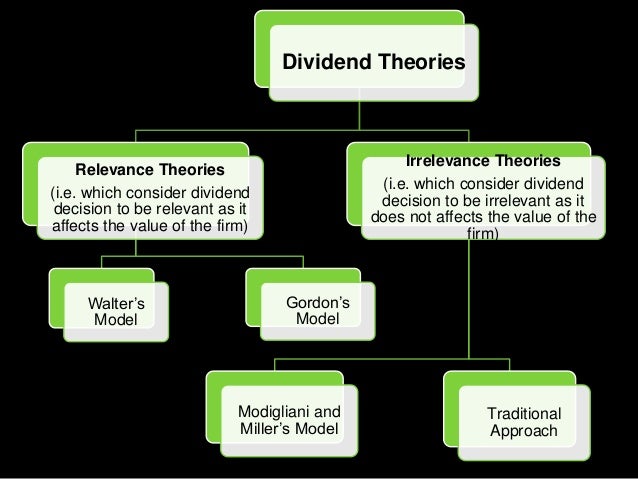
MM theory on Dividend Policy

Image result for MM theory on Dividend Policy


Modigliani- Miller Theory on Dividend Policy
According to Modigliani and Miller (M-M), dividend policy of a firm is irrelevant as it does not affect the wealth of the shareholders. They argue that the value of the firm depends on the firm’s earnings which result from its investment policy
Miller theory firmly states that the dividend policy of a company has no influence on the investment decisions of the investors.
This theory also believes that dividends are irrelevant by the arbitrage argument. By this logic, the dividends distribution to shareholders is offset by the external financing. Due to the distribution of dividends, the price of the stock decreases and will nullify the gain made by the investors because of the dividends. This theory also implies that the cost of debt is equal to the cost of equity as the cost of capital is not affected by the leverage. 
Thus, when investment decision of the firm is given, dividend decision the split of earnings between dividends and retained earnings is of no significance in determining the value of the firm. M – M’s hypothesis of irrelevance is based on the following assumptions.
1. The firm operates in perfect capital market
2. Taxes do not exist
3. The firm has a fixed investment policy
4. Risk of uncertainty does not exist. That is, investors are able to forecast future prices and dividends with certainty and one discount rate is appropriate for all securities and all time periods. Thus, r = K = Kt for all t.
Under M – M assumptions, r will be equal to the discount rate and identical for all shares. As a result, the price of each share must adjust so that the rate of return, which is composed of the rate of dividends and capital gains, on every share will be equal to the discount rate and be identical for all shares.
Thus, the rate of return for a share held for one year may be calculated as follows:
Where P^ is the market or purchase price per share at time 0, P, is the market price per share at time 1 and D is dividend per share at time 1. As hypothesised by M – M, r should be equal for all shares. If it is not so, the low-return yielding shares will be sold by investors who will purchase the high-return yielding shares.
This process will tend to reduce the price of the low-return shares and to increase the prices of the high-return shares. This switching will continue until the differentials in rates of return are eliminated. This discount rate will also be equal for all firms under the M-M assumption since there are no risk differences.
From the above M-M fundamental principle we can derive their valuation model as follows:
Multiplying both sides of equation by the number of shares outstanding (n), we obtain the value of the firm if no new financing exists.
If the firm sells m number of new shares at time 1 at a price of P^, the value of the firm at time 0 will be
The above equation of M – M valuation allows for the issuance of new shares, unlike Walter’s and Gordon’s models. Consequently, a firm can pay dividends and raise funds to undertake the optimum investment policy. Thus, dividend and investment policies are not confounded in M – M model, like waiter’s and Gordon’s models.
Criticism:
Because of the unrealistic nature of the assumption, M-M’s hypothesis lacks practical relevance in the real world situation. Thus, it is being criticised on the following grounds.
1. The assumption that taxes do not exist is far from reality.
2. M-M argue that the internal and external financing are equivalent. This cannot be true if the costs of floating new issues exist.
3. According to M-M’s hypothesis the wealth of a shareholder will be same whether the firm pays dividends or not. But, because of the transactions costs and inconvenience associated with the sale of shares to realise capital gains, shareholders prefer dividends to capital gains.
4. Even under the condition of certainty it is not correct to assume that the discount rate (k) should be same whether firm uses the external or internal financing.
If investors have desire to diversify their port folios, the discount rate for external and internal financing will be different.
5. M-M argues that, even if the assumption of perfect certainty is dropped and uncertainty is considered, dividend policy continues to be irrelevant. But according to number of writers, dividends are relevant under conditions of uncertainty.

Commerce Gurukul
for test series of upsc commerce optional and for weekend classes of upsc commerce optional at Gonda and New Delhi
Contact at - commercegurukulca@gmail.com
link to join telegram - t.me/commerce_optional

GST - Preliminary (Compilation) Part-1


  • Part I of the Constitution of India states: “India, that is Bharat, shall be a Union of States”. 
  • It provides that territory of India shall comprise the States and the Union Territories specified in the First Schedule of the Constitution of India. 
  • The First Schedule provides for twenty-nine (29) States and seven (7) Union Territories. 
  • Part VI of the Constitution of India provides that for every State, there shall be a Legislature, while Part VIII provides that every Union Territory shall be administered by the President through an ‘Administrator’ appointed by him. 
  • However, the Union Territories of Delhi and Puducherry have been Provided with Legislatures with powers and functions as required for their administration. 
  • India is a summation of three categories of territories namely – (i) States (29); (ii) Union Territories with Legislature (2); and (iii) Union Territories without Legislature (5). 
  • The State of Jammu and Kashmir enjoys a special status in the Indian Constitution in terms of Article 370 of the Indian Constitution. 
  • The Parliament has power to make laws only on Defence, External Affairs and Communication related matters of Jammu and Kashmir. 
  • As regards the laws related on any other matter, subsequent ratification by the Government of Jammu and Kashmir is necessary to make it applicable to that State. 
  • Therefore, the State of Jammu & Kashmir will have to pass special laws to be able to implement the Goods and Services Tax Acts as its current Constitutional status does not mandate the applicability of the Goods and Services Tax Acts in the State. 
  • Once the laws are passed by the State of Jammu & Kashmir, the Union Government will have to amend the Central Goods and Services Act, 2017 to delete the phrase that such provisions do not apply to the State of Jammu & Kashmir. 

1. What is GST?

GST is Goods and Service Tax. Common tax on supply of all Goods and/or Services.

2. Why GST?

To make India as One nation – One Tax – One market.
To reduce cascading effects (tax on taxes), tax evasion by using more technology for governance, Reduce Cost and complications of Compliance, etc

3. Will there be no other taxes, after introducing GST?

Yes, to some extent.
All the major indirect taxes of State and Central Governments shall be subsumed by GST. Following are the taxes subsumed:
Central Taxes: Domestic: Excise Duty, Service tax, Central Sales tax; Imports: CVD and SAD
State Taxes: VAT, Entry tax, Entertainment tax, Luxury tax and Octroi/LBT

4. Will GST be the one tax in lieu of all the above taxes?

Yes, Only one tax, GST. But levied and collected as three different components which are
CGST: Central Goods and Services tax     – Central govt. portion of the revenue
SGST: State Goods and Services tax         – State govt. portion of the revenue
IGST: Integrated Goods and Services tax– Common revenue, total of CGST and SGST, levied and Collected by Central Govt. State’s portion shall be re distributed among states, at a later point of time.

5. When to charge and collect tax under GST?

Under GST, tax should be charged on Supply of Goods or Service or Both.
No concept of Manufacture under GST. Sale of goods, Provision of Service and all other transactions shall be subsumed by treated as Supply.

6. GST is applicable for all the Supplies?

Yes, except for Liquor and Electricity.
Currently Petroleum Crude, Diesel, Petrol natural gas and ATF are also out of GST. But soon provision made to bring these into GST.
7. How to determine on which component of tax to be charged?
Though these are three components, there would be only one bifurcation Inter-state Vs Intra state.
For all the Intra-state (within the state) supplies CGST and SGST of respective state should be charged.
For all the Inter -state (Outside the state) supplies IGST should be charged
Eg. If the dealer of X product located in Hyderabad supplies to a retailer in Telangana, He should charge CGST and SGST of Telangana.
If the same dealer supplies x product to another dealer / retailers in Andhra Pradesh, He should charge IGST (Total of CGST and SGST of Andhra Pradesh).
Note: CGST & SGST shall always be charged together for Intra state supplies and IGST alone for all inter-state supplies.

8. How to determine a transaction as Interstate or Intra state supply?

There are two concepts, Location of Supplier and Place of Supply, to be compared for determining this.
Location of Supplier (LOS): Place/State from where the supply is made
Place of Supply (POS): Place/State to where the supply is made
If LOS and POS are in same state: Intra-state supply – CGST and SGST of that state should be charged.
If LOS and POS are in different states: Inter-state supply – IGST should be charged.

9. Is every supplier liable to be registered under GST?

No, a person/organization shall be registered under GST, only if his aggregate turnover in a financial year exceeds Rs20 Lakhs.
Aggregate turnover: Means total value of all the businesses of a person with same PAN.
Eg 1: If a person is having 5 different businesses, operating with his name (PAN), with 5 Lakhs annual t/o in each business, he is liable to be registered in GST.
Eg 2: For the same person, of 3 businesses are operating with his name (PAN) and two businesses are operating with his wife’s name (PAN), he and she shall not be liable for registration under GST.

10. Only one registration is sufficient?

Yes, one registration for each state in which the person has the business.
In the above example, if the person is having 5 branches in same state, he has to obtain only one registration. If the branches are in 5 different states, 5 registrations should be obtained.
Note: No concept of Centralized registrations under GST

GST on unregistered purchases


As per section 9(4), if you buy anything from an unregistered dealer then you are liable to pay the tax on his behalf on the goods/services purchased by you. Further, if you also an unregistered dealer and went on to buy inputs from another unregistered dealer then your exemption shall cease and you shall be liable to register under GST mandatorily and pay tax accordingly.

Central Government had come up with an exemption to the small miscellaneous transactions from unregistered persons. Notification No. 8/2017- Central Tax (Rate) dt 28.06.2017 issued by Central Government has exempted intra-State supplies of goods or services or both received by a registered person from any supplier, who is not registered, from the whole of the central tax leviable thereon under sub-section (4) of section 9 of the Central Goods and Services Tax Act, 2017 (12 of 2017).

The said exemption shall not be applicable where the aggregate value of such supplies of goods or service or both received by a registered person from any or all the suppliers, who is or are not registered, exceeds five thousand rupees in a day. To sum up, the supply should be intra state supply (within the state) and can be for goods as well as services or both. Moreover the supply should be received by the registered person from an unregistered dealer only and upto a daily limit of Rs. 5000/-

FAQ's
 Whether these 5000 limit be availed for those cases where compulsory tax is payable in RCM basis as per section 9(3) of CGST act?

 Where Compulsory tax is to be paid under the Reverse Charge Mechanism under 9(3) of CGST Act, and as per Notification N0o. 13/2017- Central Tax (Rate) dt 28.06.2017 the benefit of this limit cannot be availed.
 Reason being these notification cover only cases of 9(4) and not 9(3). Mr. X purchased following items from unregistered dealer, all are dated 01.07.2017 as under: 1st bill - From Ram: Stationery = 2000/- 2nd bill - From Shyam: Lunch = 1000/- 3rd bill - From Madhu: Goods Transport Agency = 3000/- In this case, The bills from Mr Ram and Mr Shyam will get covered under this notification as aggregate value of all supplies does not exceed 5000/- on a single date (01.07.2017). 

For the Third bill from Madhu Reverse charge is payable u/s 9(3) without any exemption threshold. Whether this daily limit benefits would be available if the goods/services received from persons covered under 9(4) are blocked credits?

The benefit of daily limit would be available. Output Tax under reverse charge would be payable if it crosses the daily limit even though they are covered under blocked credits. 

What if the limit crosses 5000 in a day, is GST payable over and above the value or from rupee 1? 
If the value of taxable supplies exceeds Rs5000 per day for all suppliers, then GST would be payable on the Total value of the supplies received from unregistered persons. 

Is this limit applicable to all supplies? 

The limit is applicable to only taxable supply of goods or services or both. Exempt supplies are out of the preview of this notification. Mr. X purchased following items from unregistered dealer, all are dated 01.07.2017 as under: 1st bill - From Ram: Stationery = 2000/- 2nd bill - From Shyam: Hotel Room = 1000/- 3rd bill - From Madhu: Books = 3000/- In this case, the bills of Mr. X will not get covered under this notification as aggregate value of all supplies does not exceed 5000/- on a single date (01.07.2017) as the supplies from Shyam for Hotel room booking are exempt under Entry 14 of the exemption notification (12/2017). 

What if the supplies are procured from Interstate supply from unregistered? 

Benefit of this notification is available only for Intra State Purchase. If any transactions are done on an interstate basis the same are covered under the forward charge and in any case the reverse charge provisions are not applicable. 

Goods and services both inclusive 5000 or separate?


Yes, the benefit is inclusive for all goods or services or both. 

What rate GST should be payable then? 

GST should be payable as per the schedules rate of the product/service. 

What if procured from Composition persons? 

Since Composition persons are registered person, reverse charge is not applicable on such supplies.


Can credit be availed for these taxes paid and on what basis, any invoice issue requirement? 


Credits can be availed on payment of GST in cash. A consolidated monthly tax invoice can be raised if supplies are received from a single vendor. The Invoice shall be raised on the date of receipt of goods or services or both. Also a payment voucher needs to be issued on the date of making any advance payment as the time of supply is invoice of payment whichever is earlier.


NATURE AND CONCEPT OF ORGANIZATION [an overview]

Meaning of OrganisationImage result for ORGANIZATION

Broadly speaking, the term ‘organisation’ is used in four different senses: as a process, as a structure of relationship, as a group of persons and as a system, as given below which explains Nature of Organization-

1.Organisation as a Process: In this first sense, organisation is treated as a dynamic process and a managerial activity which is essential for planning the utilization of company’s resources, plant an equipment materials, money and people to accomplish the various objectives.

For Detail Note- refer at end

2.Organisation as a Framework of Relationship/Structure- In the second sense organisation refers to the structure of relationships and among position jobs which is created to release certain objectives. The definitions of Henry, Urwick, Farland, Northcourt, Lansburgh and Spriegel Breach, Davis, Mooney and Reily etc., come under this group. For example: According to Mooney and Reily, “Organisation is the form of every human association for the attainment of a common purpose.”

For Detail Note- refer at end

3.Organisation as a Group of persons: In the third sense, organisation is very often viewed as a group of persons contributing their efforts towards certain goals. Organisation begins when people combine their efforts for some common purpose. It is a universal truth that an individual is unable ability and resources. Barnard has defined ‘Organisation’ as an identifiable group of people contributing their efforts towards the attainment of goals.

4.Organisation as a System: In the fourth sense, the organisation is viewed as system. System concepts recognize that organizations are made up of components each of which has unique properties, capabilities and mutual relationship. The constituent element of a system are linked together in such complex ways that actions taken by one producer have far reaching effect on others.

Louis Allen, “Organization is the process of identifying and grouping work to be performed, defining and delegating responsibility and authority and establishing relationships for the purpose of enabling people to work most effectively together in accomplishing objectives.” 
  • In the words of Allen, organization is an instrument for achieving organizational goals. The work of each and every person is defined and authority and responsibility is fixed for accomplishing the same.

Wheeler, “Internal organization is the structural framework of duties and responsibilities required of personnel in performing various functions within the company………… It is essentially a blue print for action resulting in a mechanism for carrying out function to achieve the goals set up by company management”. 
  • In Wheeler’s view, organization is a process of fixing duties and responsibilities of persons in an enterprise so that business goals are achieved.

Koontz and O’Donnell, ‘The establishment of authority relationships with provision for co-ordination between them, both vertically and horizontally in the enterprise structure.” 
  • These authors view organization as a coordinating point among various persons in the business.

Oliver Sheldon, “Organization is the process so combining the work which individuals or groups have to perform with the facilities necessary for its execution, that the duties so performed provide the best channels for the efficient, systematic, positive and coordinated application of the available effort”. 
  • Organization helps in efficient utilization of resources by dividing the duties of various persons.

Spriegel, “In its broadest sense organisation refers to the relationship between the various factors present in a given endeavor. Factory organisation concerns itself primarily with the internal relationships within the factory such as responsibilities of personnel, arrangement and grouping of machines and material control. From the standpoint of the enterprise as a whole, organisation is the structural relationship between the various factors in the enterprise”.
  • Spriegel has given a wide definition of the organization. He has described it as the relationship among persons, factors in the enterprise. All factors of production are coordinated in order to achieve organisational objectives.

George Terry, “Organising is the establishing of effective authority relationships among selected work, persons, and work places in order for the group to work together efficiently”. 
  • According to Terry organisation is the creation of relationship among persons and work so that it may be carried on in a better and efficient way.

C.H. Northcott, ‘The arrangement by which tasks are assigned to men and women so that their individual efforts contribute effectively to some more or less clearly defined purpose for which they have been brought together”.
  • According to Northcott the purpose of organisation is to co-ordinate the activities of various individuals working in the organisation for the attainment of enterprise goals.

L.H. Haney, “Organisation is a harmonious adjustment of specialised parts for accomplishment of some common purpose or purposes”. 
  • Organisation is the adjustment of various activities for the attainment of common goals.

Keith Davis, “Organisation may be defined as a group of individuals, large of small, that is cooperating under the direction of executive leadership in accomplishment of certain common object.”

Chester I. Barnard, “Organisation is a system of co-operative activities of two or more persons.”

[NOTE- No need to learn each definition. As seen in previous year questions UPSC use one of definition and ask to features of Organization oe explain, etc. So,One just read so that can answer confidently. Can learn one definition and quoting it give value addition.]

Concepts of Organisation:

There are two concepts of organisation: 
1. Static concept
2. Dynamic concept

1. Static Concept:

Under static concept the term ‘organisation’ is used as a structure, an entity or a network of specified relationship. In this sense, organisation is a group of people bound together in a formal relationship to achieve common objectives. It lays emphasis on position and not on individuals.

2. Dynamic Concept:

Under dynamic concept, the term ‘organisation’ is used as a process of an on-going activity. In this sense, organisation is a process of organising work, people and the systems. It is concerned with the process of determining activities which may be necessary for achieving an objective and arranging them in suitable groups so as to be assigned to individuals. It considers organisation as an open adoptive system and not as a closed system. Dynamic concept lays emphasis on individuals and considers organisation as a continuous process.

Characteristics of Organisation:

Different authors look at the word ‘organisation’ from their own angle. One thing which is common in all the viewpoints is that organisation is the establishment of authority relationship among persons so that it helps in the achievement of organisational objectives.

Some of the characteristics of organisation are studied as follows: