Showing posts with label GST- GOODS AND SERVICE TAX. Show all posts
Showing posts with label GST- GOODS AND SERVICE TAX. Show all posts

GST BOOK- Sample of THEORY
 GOODS AND SERVICE TAX- GST
 |
| GST Connecting INDIA with the WORLD in ECONOMY DEVELOPMENT. |
Choose the right book is like choosing to learn right concept and progressing every day. Commerce Gurukul Team have its Telegram Groups where students interacts with thousands of students and help to each other in sharing knowledge and clearing queries.
BOOK includes- Acts and Rules in specific supported by Flowcharts,etc which help students in various ways-Example-
- INCREASE ability to understand Legal terms and their understanding.
- Helpful to CLEAR Concepts (importance of SHALL/MAY, OR/AND, etc which change the meaning of interpretation).
- Helpful in preparation of Other subjects too... (HOW??? Ans- it increase ability automatically to create formula for long para/theory, ability to create short notes, etc)
- HELPFUL in REVISION
- at end helpful in SUCCESS in EXAMINATION
Save time with smart learning in GST with COMMERCE GURUKUL BOOK > Focus in other subject increase > Increase number of times REVISION > CLEAR EXAM in first attempt > SAVE TIME > Contribute towards your SUCCESS.
SAMPLE-
1st lot is completely sold out and unstock.
ADVANCE BOOKING for Next lot - MORE YOU DELAY, MORE YOU LOOSE TIME, TIME PASS ON but exam dates are Fixed that not wait for your decision....

WHAT IS GST?
- GST, the ‘destination tax’
- The most revolutionary tax reform in the Indian taxation history; will streamline the system through a single tax for supply of all goods and services across the country.
- In India, the unified tax will take the form of a “dual” GST, to be levied concurrently by both the Centre and states.
- The unified tax will comprise of a Central GST and a State GST, which will be legislated, levied and administered by the respective levels of government. The same taxable base will be subject to both GSTs.
- The words “legislate, levy and administer” are key, since the Centre and the state will legislate the respective GST Acts and both will have power to administer the taxes.
- The proposed tax system will subsume a variety of central and state levies such as Central Excise Duty, Service Tax and VAT, thereby simplifying the complicated tax structure and reducing compliance costs.
- GST is a value added tax levied on manufacture, sale and consumption of goods and services.
- ...........................
REVERSE CHARGE MECHANISM
After Studying this Chapter, you will able to know-
- Meaning of Reverse Charge……………….
- Types of Reverse Charge……………………….
- Registration……………….
- Input Tax Credit (ITC)……………….
- Time of Supply ……………….
- Compliances ……………….
- Supplies of Goods ……………….
- Supplies of Services ……………….
- Notification No. 10/2017- IGST……………….
Supplies of Services under Reverse Charge Mechanism
- SERVICE- GTA Services.
- SUPPLIER- Goods Transport Agency (GTA).
- RECIPIENT- Any factory, society, co-operative society, registered person, body corporate, partnership firm, casual taxable person; located in the taxable territory.
- SERVICE- Legal Services by advocate.
- SUPPLIER- An individual advocate, including a senior advocate or a firm of advocates.
- RECIPIENT- Any business entity located in the taxable territory.
- SERVICE- Services supplied by an arbitral tribunal to a business entity.
- SUPPLIER- An arbitral tribunal.
- RECIPIENT- Any business entity located in the taxable territory.
- SERVICE- Services provided by way of sponsorship to any body corporate or partnership firm.
- SUPPLIER- Any person.
- RECIPIENT- Any body corporate or partnership firm located in the taxable territory
Latest and Student friendly book on Goods and Service Tax (GST)- Relevant for coming exam
GST Student friendly Book most relevant/Useful for CA Intermediate/IPCC, CS executive , CWA Intermediate and CA final. ALSO useful for B.Com / M.Com / MBA/ BBA/UPSC/ SSC and Various Govt Exams.!! This book is approved by Ministry of HRD Govt.of India as Students friendly book.
Author Name- CA Harshita Raichandani and CA Dhananjay Ojha

Book has been published in student friendly completely.Most relevant GST book from exam point of view. Say good bye to lengthy paras... switch to new era of learning.
Learn by- Bullets, Diagrams, Charts, Pictures/Clips.
MAKE LEARNING CREATIVE and MEMORISING FACTS ON YOUR TIPS.
Unique features of This GST Book/Benefits of purchasing This Book.
- 80+ GST chart included for quick revision of chapter.
- Provisions presented in this book in simple manner.
- Bullet and Heading given for Long term memorisation.
- Updated upto 25th GST council recommendation {18th January, 2018}
- 70+ Value added questions given with answer.
- 16 Chapters fully Coverage given.
- Definitions of Technical term related with GST is given at one place
- Most useful for CA Intermediate/IPCC, CS executive , CWA Intermedite and CA final. ALSO useful for B.Com / M.Com / MBA/ BBA/UPSC/ SSC and Various Govt Exams.
INDEX of GST Book - Index of GST Book
Preface and About Author of GST Book - About Author
Purchase price Rs.776 Including courier charges Rs. 80. Click on payment link (given below) to pay Rs.696+80 Couriers Charges=776. to purchase latest and student friendly GST Book to get better marks in Exam.Limited Stock available.Purchase Now.

Option 1 for Payment-Online Banking.
A/C Name- COMMERCE GURUKUL
A/C No- 50200029094052
IFSC CODE- HDFC0001901
Option 2 for Payment- Pay u money.

Option 3 for Payment -Paytm.
Option 1 for Payment-Online Banking.
A/C Name- COMMERCE GURUKUL
A/C No- 50200029094052
IFSC CODE- HDFC0001901
Option 2 for Payment- Pay u money.
Paytm Mobile No.- 9911020626
After making payment please fill this google's order form ( Blue Link given below) to get delivery of Commerce Gurukul's GST student friendly Book.
Book Order FormThanks and with Best wishes
Commerce Gurukul (Educational Institute for Commerce Students, Chartered Accountant Students and UPSC students) Mail ID - commercegurukulbooks@gmail.com
Website- www.comgurukul.com
About Author - CA Harshita Raichandani and CA Dhananjay Ojha
CA Harshita Raichandaniis a qualified Chartered Accountant and Associate member of the Institute of Chartered Accountants of India. Co-Founder of Bharat Gurukul -Parent Company of Commerce Gurukul.
She holds a Bachelor degree and Master degree in Commerce and Accountancy. She is Masters in Business Administration (MBA) and Certified Accounting Technician also. She secured distinctions in various subjects of Commerce and Accountancy.
She has over 4 years of teaching experience in field of Commerce and Accountancy. Her students result with minimum 60% passing score in first attempt and stay dream oriented to Serve Nation.
She is consultant in Goods and Service Tax. She has written various Bulletins, Books including CA Student Friendly Books and Articles on Tax and Accountancy.
She is Co-Author of book named as “INDIAN ECONOMY”.
She did various awareness sessions at various institutions and public platforms on choosing right course & strategy and help students to stay motivated. Presently, She is guiding students all over the world through Bharat Gurukul.
CA Dhananjay Ojha is a qualified Chartered Accountant and Associate member of the Institute of Chartered Accountants of India. Co-Founder of Bharat Gurukul -Parent Company of Commerce Gurukul.
He did B.Com. (Hons.) from St. Xavier's College, Kolkata with specialization in “Accounting and Finance”. He has completed NCFM course by scoring 97%.
He has over 6 years of teaching experience in field of Commerce and Accountancy at professional forum.
He is consultant in various Government Department and Listed Corporates on Taxation (Income tax and GST), Financial reporting and Audit matters.
He has presented Research papers on “IND AS” at national level seminar at St. Xavier's College, Kolkata.
He is leading author of a book named as “INDIAN ECONOMY”. Presently, He is guiding students all over the world through Bharat Gurukul.
Composition Scheme Under GST
Composition Levy – Section 10 of CGST Act
1. The Composition Scheme for small businesses has given to help them with maintaining minimum compliance.
2. This Composition Scheme will make compliance with tax laws hassle free for eligible businesses opting for the scheme.
3.The composition levy is an alternative method of levy of tax designed for small taxpayers whose turnover is up to Rs. 1.5 crore and pays a flat rate of tax regardless of what they manufacture, provide as a service or trade they carry on.
Conditions for Opting for Composition Scheme under GST:
The conditions for opting Composition scheme under GST are as follows:
No Credit of Input Tax
Any dealer registered under Composition Scheme will not be eligible to take credit of Input Tax credit on purchases. Also, the buyer of those goods will not get the credit of taxes paid.
No Inter-state business
The major drawback of this scheme is that the assessee cannot deal in interstate transactions or affect import – export of goods and services. He is barred from performing such actions which limit his territory for expansion and can only conduct local or intra state transactions.
Pay tax from own pocket
Since the dealer is not allowed to charge tax from his buyer, despite the rate being very low, he has to pay out of his own pocket. He is not even allowed to issue a tax invoice, resulting the burden on the assessee to pay tax.
Strict Penal provisions
Utmost care is required while taking benefit of composition levy under GST regime as the penal provisions are quite severe. If by any chance, it is proved that the assessee is wrongly registered under this scheme, not fulfilling the required criteria and thereby avoiding taxes will face bad consequences. He will be then be asked to pay taxes along
Question and Answer:-
1. Who can opt for Composition Scheme?
Businesses with annual turnover upto Rs 1.5 crore can opt for composition scheme.
Turnover of all businesses with same PAN has to be added up to calculate turnover for the purpose of composition scheme.
2. What is the tax rate applicable to a Composition Dealer?
Please see the chart below to understand the tax rate applicable:

3. I am purchasing goods from an unregistered dealer. Do I need to pay tax?
Tax at normal rates has to be paid on purchases from an unregistered dealer only for the months of July and August 2017. From September there is no need to pay tax on these purchases. No ITC is available on tax paid under reverse charge.
4. How should the Tax amount be calculated?
A composition dealer is required to pay tax at a specific rate on total sales.
9. Can a Composition Dealer collect tax from customers?
No, a Composition Dealer is not allowed to collect composition tax from the buyer.
The declaration of change can be submitted on the GST Portal.
12. I have many branches. Will composition scheme apply to each of them separately?
If Composition Scheme is opted for all businesses that are associated with this PAN
1. The Composition Scheme for small businesses has given to help them with maintaining minimum compliance.
2. This Composition Scheme will make compliance with tax laws hassle free for eligible businesses opting for the scheme.
3.The composition levy is an alternative method of levy of tax designed for small taxpayers whose turnover is up to Rs. 1.5 crore and pays a flat rate of tax regardless of what they manufacture, provide as a service or trade they carry on.
Conditions for Opting for Composition Scheme under GST:
The conditions for opting Composition scheme under GST are as follows:
a) The person opting for composition levy should be a registered person.
b) Aggregate turnover of registered person in the preceding Financial Year should not exceed Rs.1.5 crore.
c) Following class of registered persons would not be entitled to opt for Composition Scheme.
- person engaged in supply of services would not be eligible to opt for composition levy except for person engaged in supply of food for human consumption.
- Person making any supply of goods which are not leviable to tax under this Act. At present following goods are not leviable to tax under this Act:
¨ Petroleum Crude
¨ High Speed Diesel
¨ Motor Spirit
¨ Natural Gas
¨ Aviation Turbine Fuel
¨ Alcohol for Human Consumption
- Person making any inter-State outward supplies of goods.
- Person making any supply of goods through an electronic commerce operator who is required to collect tax at source under section 52.
- Person who is a manufacturer of such goods as may be notified by the Government on the recommendation of the Council.
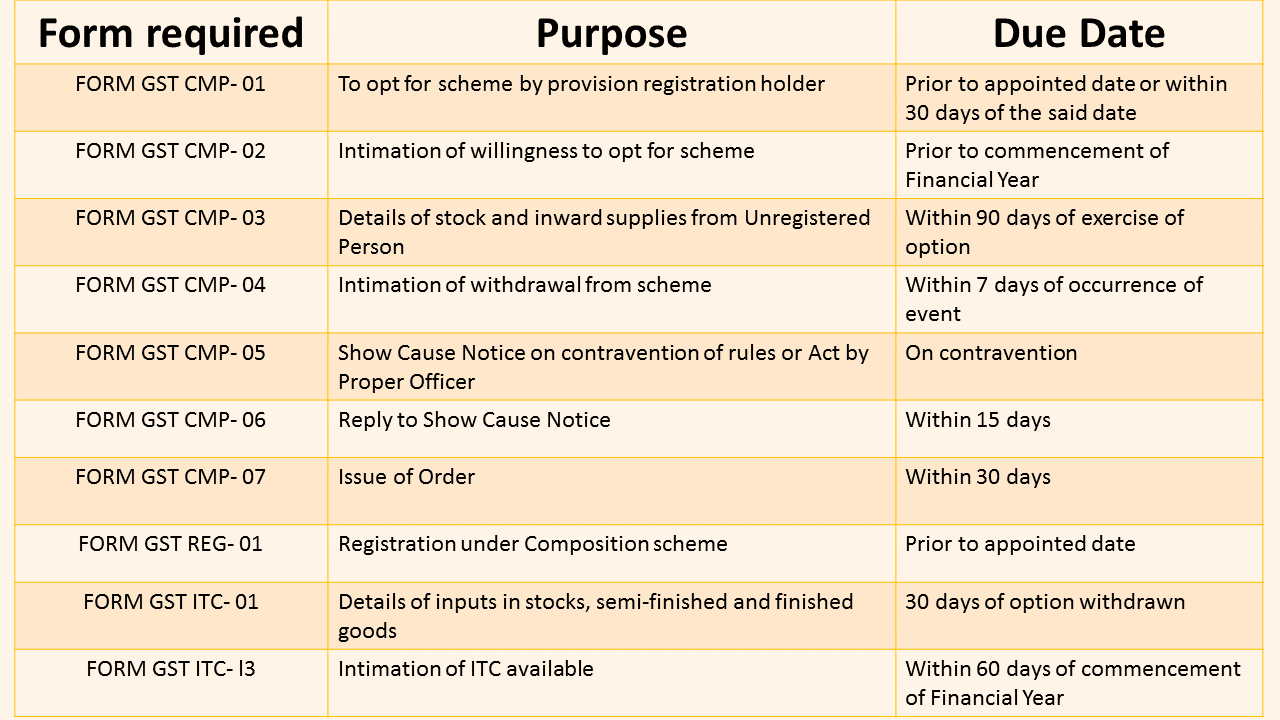
Composition Scheme forms
Composition Scheme Rules under GST provides for submission of different forms meant for respective purposes followed by due date for submission of such forms, which are as follows:Limitations of GST Composition Scheme
There are some of the limitations that every business owner must be aware of:No Credit of Input Tax
Any dealer registered under Composition Scheme will not be eligible to take credit of Input Tax credit on purchases. Also, the buyer of those goods will not get the credit of taxes paid.
No Inter-state business
The major drawback of this scheme is that the assessee cannot deal in interstate transactions or affect import – export of goods and services. He is barred from performing such actions which limit his territory for expansion and can only conduct local or intra state transactions.
Pay tax from own pocket
Since the dealer is not allowed to charge tax from his buyer, despite the rate being very low, he has to pay out of his own pocket. He is not even allowed to issue a tax invoice, resulting the burden on the assessee to pay tax.
Strict Penal provisions
Utmost care is required while taking benefit of composition levy under GST regime as the penal provisions are quite severe. If by any chance, it is proved that the assessee is wrongly registered under this scheme, not fulfilling the required criteria and thereby avoiding taxes will face bad consequences. He will be then be asked to pay taxes along
Question and Answer:-
1. Who can opt for Composition Scheme?
Businesses with annual turnover upto Rs 1.5 crore can opt for composition scheme.
Turnover of all businesses with same PAN has to be added up to calculate turnover for the purpose of composition scheme.
2. What is the tax rate applicable to a Composition Dealer?
Please see the chart below to understand the tax rate applicable:
3. I am purchasing goods from an unregistered dealer. Do I need to pay tax?
Tax at normal rates has to be paid on purchases from an unregistered dealer only for the months of July and August 2017. From September there is no need to pay tax on these purchases. No ITC is available on tax paid under reverse charge.
4. How should the Tax amount be calculated?
A composition dealer is required to pay tax at a specific rate on total sales.
5. Should a Composition Dealer maintain detailed records?
No, a dealer registered under composition scheme is not required to maintain detailed records as required by a normal taxpayer.
6. Can Composition Dealers avail Input Tax Credit?
No, a Composition Dealer is not allowed to avail input tax credit of GST on purchases.
7. Can a Composition Dealer issue Tax Invoices?
A Composition Dealer has to issue Bill of Supply. They cannot issue a tax invoice. This is because the tax has to be paid by the dealer out of pocket. A Composition Dealer is not allowed to recover the GST from the customers.
8. What are the returns to be filed by a Composition Dealer?
The taxable person is required to furnish only one return i.e. GSTR-4 on a quarterly basis and an annual return in FORM GSTR-9A.9. Can a Composition Dealer collect tax from customers?
No, a Composition Dealer is not allowed to collect composition tax from the buyer.
10. Can a dealer involved in interstate supplies opt for Composition Scheme?
Composition Scheme is available only for dealers doing intra-state supplies. If a dealer is involved in inter-State supplies, then they have to opt out of the scheme.
11. Can I opt for Composition Scheme in one year and opt out in next year?
Yes, this is possible. You can opt to switch between the Composition Scheme and the normal scheme based on your turnover. However, you will have to keep in mind that this will affect the way you issue invoices and file your returns.The declaration of change can be submitted on the GST Portal.
12. I have many branches. Will composition scheme apply to each of them separately?
If Composition Scheme is opted for all businesses that are associated with this PAN
13. Is it true that Composition Dealers can sell a product at a lower price than regular dealers?
Yes. Composition dealers cannot charge GST on their sales. So the end consumer pays less money than usual.National Anti-profiteering Authority
The Government has approved the constitution of a National Anti-Profiteering Authority (NAA) – the institutional mechanism under the GST law to check the unfair profit-making activities by the trading community. Union Cabinet chaired by the PM decided for the appointment of a Chairman and Technical Members of the Authority.
Introduction:
Introduction:
National Anti-profiteering Authority is
an apex body which is mandated to ensure
that the benefits of the reduction in GST rates on goods or services are
passed on to the ultimate consumers by
way of a reduction in prices.
Just for additional information: It is headed by Secretary level officer to
GOI and 4 technical members from state and/or Center.
Points
to be covered:
Mandates:
·
Anti-profiteering measures.
·
Pass reduction benefits to consumers.
·
Consumer welfare fund.
·
Penalty
·
Cancellation of registration.
Need for NAA in post GST India.
1.
Monitoring:
·
Profiteering: Firms in order to derive
quick profits may not pass on benefits to consumers. Ex: One fast food MNC
chain had not passed on reduction benefit to consumers.
·
GST: Without passing, the objectives of
reducing GST won’t be fulfilled.
1. Past experiences: Have shown the benefits have not been passed on.
2. Rate changes: There are provisions for revision of rates even
further.
Conclusion:
Protecting the interests of both consumers and Business houses is the responsibility of government.
Even if one is compromised then economic prosperity is compromised in long run.
Thus constitution of the NAA shall bolster confidence of consumers as they
reap the benefits of the recent
reduction in GST rates, in particular, and of GST, in general.
Mandatory Compliance of e-way Bill in GST
The GST Council at its 24th meeting held on 16th December’2017 on an urgent meeting through video conferencing to discuss implementation of e-way bill system under the Goods and Services Tax (GST) regime approved Mandatory Compliance of e-Way Bill.
After review of the status of the hardware and software framework required for implementation of the e-way bill system and in consultation with the states, GST council recommended following :
- Nationwide e-way bill system will be available on trial basis from January 16, 2018 for traders and transporters to use voluntarily.
- The Rules governing the compulsory implementation of the e-way bill system across India for Inter-State movement of goods will be notified on February 1, 2018.
- States have time till 1 June to implement the national e-way bill system for Intra-State goods movement.
- Mandatory Compliance of e-way bill for intra-state movement of goods from 1 June 2018. While the system for both inter-state and intra-state e-way Bill generation will be ready by January 16, the states may choose their own timings for implementation of e-way Bill for intra-state movement of goods on any date before June 1, 2018
What is E-Way Bill
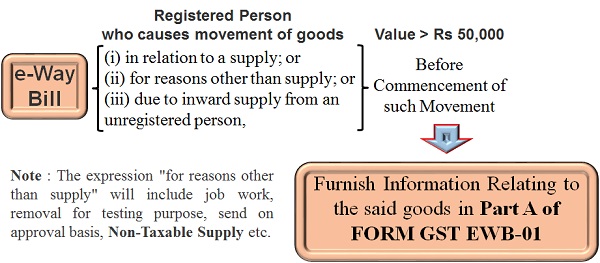
Under the GST regime, Electronic Way Bills (E-way Bills) will be the primary document for transportation of the goods. e-way bill is a document required to be carried by a person in charge of the conveyance carrying any consignment of goods of value exceeding fifty thousand rupees as mandated by the Government in terms of Section 68 of the Goods and Services Tax Act read with Rule 138 of the rules framed thereunder. It is generated from the GST Common Portal by the registered persons or transporters who causes movement of goods of consignment before commencement of such movement. An e-way bill is required for movement of goods worth more than Rs 50,000.
Why E- Way Bill
E-Way Bill will be meant to bring uniformity across states for seamless inter-state movement of goods.
Implementation of this system could lead to significant supply chain de-bottlenecking to reduce transaction time and other compliance related issues.
The mechanism will help the tax authorities monitor inter-state and intra-state movement of goods
22 states have abolished border commercial tax check posts. Many states have also issued advisories to field to not stop trucks. This move will allow seamless movement of goods across the border, ending waiting hours for commercial vehicles. Seamless transport is expected to cut transport costs which will help make goods cheaper. E-Way Bill provides authenticity of movement of goods.
The e-way bill mechanism has been introduced in the GST regime to plug tax evasion loopholes. Tax evasion was one of the reasons cited by the government for the fall in revenue collection in October.
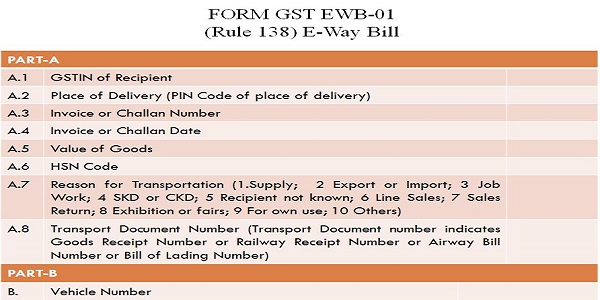
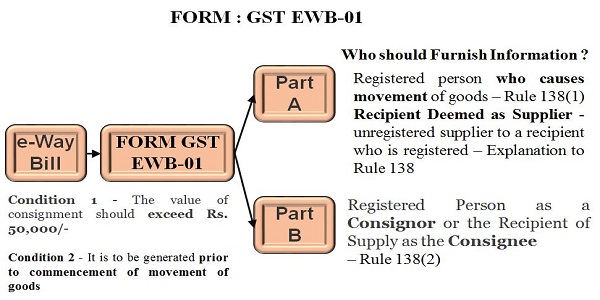
Who Should Furnish E-Way Bill
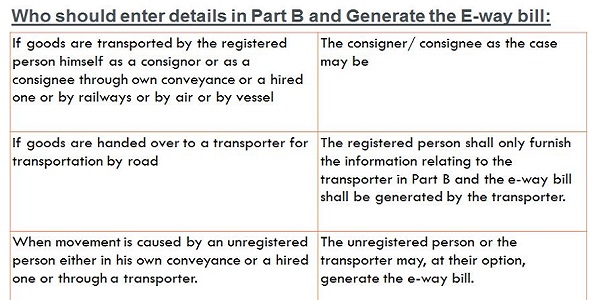
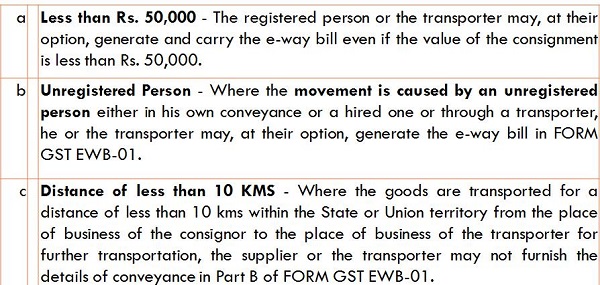
Optional E-Way Bill
In following transactions, the generation of e-way bill is optional:
When E-Way Bill not Required:
Rule 138(14)
Notwithstanding anything contained in this rule, no e-way bill is required to be generated—
(a) where the goods being transported are specified in Annexure;
(b) where the goods are being transported by a non-motorised Conveyance;
(c) where the goods are being transported from the port, airport, air cargo complex and land customs station to an inland container depot or a container freight station for clearance by Customs; and
(d) in respect of movement of goods within such areas as are notified under clause (d) of sub-rule (14) of rule 138 of the Goods and Services Tax Rules of the concerned State.
Rule 138(7) -Transporter May Generate FORM GST EWB-01
Where the consignor or the consignee has not generated FORM GST EWB-01 in accordance with the provisions of sub-rule (1) and the value of goods carried in the conveyance is more than fifty thousand rupees, the transporter shall generate FORM GST EWB-01 on the basis of invoice or bill of supply or delivery challan, as the case may be, and may also generate a consolidated e-way bill in FORM GST EWB-02 on the common portal prior to the movement of goods.
Rule 138(8) – Information Available on Portal
The information furnished in Part A of FORM GST EWB-01 shall be made available to the registered supplier on the common portal who may utilize the same for furnishing details in FORM GSTR-1
If goods not Transported as per e-Way Bill Generated
Rule 138(9)
Where an e-way bill has been generated under this rule, but goods are either not transported or are not transported as per the details furnished in the e-way bill, the e-way bill may be cancelled electronically on the common portal, either directly or through a Facilitation Centre notified by the Commissioner, within 24 hours of generation of the eway bill:
Provided that an e-way bill cannot be cancelled if it has been verified in transit in accordance with the provisions of rule 138B.
Validity of e-way bill
Rule 138(10) An e-way bill or a consolidated e-way bill generated under this rule shall be valid for the period as mentioned below :
i. Upto 100 Km – 1 day
ii. For every 100 km or part thereof thereafter – One additional day
The period of validity shall be counted from the time at which the e-way bill has been generated and each day shall be counted as twenty four hours.
EBN Number: Upon generation of e-way bill on the common portal, a unique e-way bill number (EBN) shall be made available to the supplier, the recipient and the transporter on the common portal – Rule 138(11)
Acceptance or rejection of e-way bill: The details of e-way bill generated shall be made available to the recipient, if registered who shall communicate his acceptance or rejection of the consignment. Where no communication is made within 72 hours, then it shall be deemed that he has accepted the said details – Rule 138(12)
The e-way bill generated under this rule or under rule 138 of the Goods and Services Tax Rules of any State shall be valid in every State and Union territory – Rule 138(13)
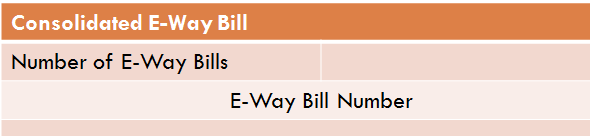
Rule 138(5) – Transferring goods in transit: If a transporter is transferring goods from one conveyance to another in the course of transit then he shall update the details of conveyance in the e-way bill before such transfer and further movement of goods. Rule 138(6) – Multiple consignments: If multiple consignments are intended to be transported in one conveyance, then the transporter may indicate the serial number of e-way bills of each consignment and a consolidated e-way bill may be generated by him prior to the movement of goods.
FORM GST EWB-02 : Consolidated E-Way Bill
Supply by unregistered person:
In case of supply by an unregistered person to a registered recipient, then the movement shall be said to be caused by registered recipient if such recipient is known at the time of commencement of the movement of goods.
Exceptional circumstances:
If goods cannot be transported within the validity period of the e-way bill due to circumstances of an exceptional nature, then the transporter may generate another e-way bill after updating the details in Part B.
9 FAQs on GST replied by GOI on its twitter handle on 18.12.2017
Question 1: services in the nature of license fees obtained from outside India, Is RCM applicable om this??
Answer: The query is not clear. However if it is import of services, RCM is applicable. Refer Notfn., 10/2017-IT Rate. dated 28.6.2017.
Question 2: One of my client having itc 39 lak he is doing a business of textiles to export. He opt at the time of shipment with out payment of igst. In gst portal now refund option is available. May i claim refund of itc by filing rfd1 right now or else suggest me?
Answer: U can claim refund of accumulated credit. Pl. refer circular 17/17/2017 dt. 15.11.2017 for detailed procedure.
Question 3: Is RCM applicable for service & software import by IT company for export Services or full fill international client needs?
Answer: Yes. Import is considered as interstate supply. Refer Sec 7 of IGST Act.
Question 4: I am Exporter of services. My all receipts will be in foreign currency. My aggregate turnover for the FY 2017-18 will be INR 12.00 Lakhs. Whether I require to take registration under GST. No input GST is involved in my business.
Answer: Persons making any interstate taxable supply has to take registration. Refer Sec 24(1).
Question 5: Purchased out of India, Sale out of India, Any GST compliance required in India is above transaction done by Indian Company?
The facts given are not enough to determine levy. Pl. refer Sec 5,7,11 of IGST Act.
Question 6: whether CMP-3 to be filed by persons who were already in composition scheme in pre GST era and persons who were dealing in Tax free goods like fabrics (now opted for Composition )
Answer: Yes
Question 7: Sir. How to apply for cancellation of gst registration applied voluntarily, since igst notification 10/2017 exempt service provider with value of services less than 20lakhs from obtaining registration
Answer: Pl. apply in form REG-16. In case of any difficulty in system write to @askGSTech.
Question 8: Composition dealer Registered on 19.09.2017. Form GSTR 4 for July-Sept NOT available on GSTR Portal. How to file return for that period ?
Answer: U can filed GSTR 4 upto 24th Dec, 2017. Any system difficult write to @askGSTech .
Question 9: What should I do. If 3B and Gstr 1,2,3 didn’t match?
Answer: GSTR 1,2,3 are periodic returns whereas 3B is only summary interim return. If there is any difference tax liability in regular returns same need to be paid with consequential effects.
GST - Preliminary (Compilation) Part-2
Goods and Services Tax Council (GSTC):
The GSTC has been notified with effect from 12th September, 2016. GSTC is being assisted by a Secretariat. The following major decisions have been taken by the GSTC as on 3rd June,2017-
(i) The threshold exemption limit would be Rs. 20 lakh.
• For special category States enumerated in article 279A of the Constitution, threshold exemption limit has been fixed at Rs. 10 lakh.
(ii) Composition threshold shall be Rs. 50 lakh.
• Composition scheme shall not be available to
- inter-State suppliers,
-service providers (except restaurant service) and
-specified category of manufacturers.
(iii) Existing tax incentive schemes of Central or State governments may be continued by respective government by way of reimbursement through budgetary route. The schemes, in the present form, would not continue in GST.
(iv) There would be four tax rates namely 5%, 12%, 18% and 28%.
• The tax rates for different goods and services have been finalized.
• Besides, some goods and services would be under the list of exempt items.
• The exempted services has been finalized which is same as the services exempted under existing service tax law, except services supplied by Goods and Services Tax Network which is the addition to the list of exempted services under service tax.
• Rate for precious metals is an exception to ‘four-tax slab-rule’ and the same has been fixed at 3%.
• A cess over the peak rate of 28% on certain specified luxury and demerit goods, like tobacco and tobacco products, pan masala, aerated waters, motor vehicles, would be imposed for a period of five years to compensate States for any revenue loss on account of implementation of GST.
• The list of services in case of which reverse charge would be applicable has also been finalized.
(v) The five laws namely CGST Law, UTGST Law, IGST Law, SGST Law and GST Compensation Law have been recommended.
(vi) In order to ensure single interface, all administrative control over 90% of taxpayers having turnover below Rs. 1.5 crore would vest with State tax administration and over 10% with the Central tax administration.
• Further all administrative control over taxpayers having turnover above Rs. 1.5 crore shall be divided equally in the ratio of 50% each for the Central and State tax administration.
(vii) Powers under the IGST Act shall also be cross-empowered on the same basis as under CGST and SGST Acts with few exceptions.
(viii) Power to collect GST in territorial waters shall be delegated by Central Government to the States
(ix) Formula and mechanism for GST Compensation Cess has been finalised.
(x) Nine rules on registration, composition levy, valuation, tax invoice, input tax credit, payment, returns, refund and transitional provisions have been recommended.
(xi) www.gst.gov.in, managed by GSTN, shall be the Common Goods and Services Tax Electronic Portal.
(xii) Rate of interest on delayed payments and delayed refund has been recommended.
(xiii) Rate of TCS has been recommended.
Que.11 Is there any option of paying TOT / Composition scheme under GST?
Yes, if the aggregate t/o is less than Rs.75 Lakhs. Then the person can opt to register under Composition scheme and to pay fixed % (2%/1%/5%) of total turnover as tax.
However, this scheme applicable for supplier of Goods and Restaurants. A Service provider doesn’t have an option of paying tax under Composition scheme.
Que.12 When to pay tax under GST?
A registered person shall be liable to pay tax on monthly basis, before filing the return for the month.
For Composition scheme, tax shall be paid and returns to be filed on quarterly basis.
Que.13 What are all the returns to be filed under GST?
Every registered person shall be liable to file a minimum of 3 returns on monthly basis
1. Outward Supplies – by 10th of the following month
2. Inward supplies – by 15th of the following month
3. Final return – by 20th of the following month
And one annual return, by 31st December of the following financial year.
For composition scheme, Quarterly returns to be filed by 18th of the 1st month of the following quarter.
Que.14 Reverse charge Mechanism (RCM) continues under GST?
Yes, RCM continues under GST also. For specified goods and services, Recipient shall be liable to pay tax, instead of supplier.
Also, if any purchases are made / services are availed by a registered person from an Unregistered person, such registered person shall be liable to pay tax under RCM.
However the same can be availed as Input credit.
Que.15 Does the MODVAT / Input tax credit (ITC) Mechanism continues under GST?
Yes, ITC mechanism is the Back bone of GST. GST paid on all the Purchases made and Expenses incurred in the course or furtherance of business shall be allowed as credit.
Note: There are few restricted expenses, for which credit shall not be allowed.
Que.16 How can we use the credit among the three components of tax?
IGST can be used for payment of IGST, CGST and SGST in that order
CGST can be used for payment of CGST and IGST in that order
SGST can be used for payment of SGST and IGST in that order
Cross utilization of CGST and SGST is not allowed
Note: Input taxes of one state can’t be utilized for discharging tax liability of other state.
Que.17 What is the matching concept under GST?
Under GST, for allowing the input tax credit, all the inward supplies declared by taxable person shall be matched with the outward supplies declared by the supplier.
• Credit shall be allowed to the recipient, to the extent of taxes paid by the supplier only.
• If the supplier doesn’t pay tax / fails to file the return, recipient shall not get the ITC for the purchases made from that supplier.
This matching is done in the GST network, on the basis of Invoice number and TIN provided by the supplier and recipient. Mismatch report shall be communicated to each of them and sufficient time is given for reconciling the same, before filing the returns.
Que.18 What are different types of supplies covered under the definition of ‘Supply’?
Supplies include all forms of supply of goods and/or services such as sale, transfer, barter, exchange, license, rental, lease or disposal made or agreed to be made for a consideration by a person in the course or furtherance of business.
• It also includes Importation of services, for a consideration whether in the course or furtherance of business.
• Further, following Schedules cover various supplies:
Supplies made without consideration - Schedule I
Determining what is to be treated as goods / services - Schedule II
Activities or Transactions neither Supply of goods nor Supply of services-Schedules III & IV
Que.19 . What are different forms of supply of goods?
Indicative list of supply of goods are sale, transfer, barter, exchange, license, rental, lease or disposal made or agreed to be made for a consideration by a person in the course or furtherance of business.
Que.20 What is Composite Supply and how it is taxable?
Composite supply means a supply made by a taxable person to a recipient comprising of two or more goods or services or any combination thereof, naturally bundled for supply in the ordinary course of business, wherein one of the components has the essential character of ‘supply ’is known as principle supply.
This composite supply shall be taxable at the rate applicable to principle supply.
For Example: In a natural bundle of supply of goods and insurance service on transportation, supply of goods is the essential supply and the rate applicable to such goods would be applicable for this composite supply.
Subscribe to:
Posts (Atom)